
Solutions
Energy storage solutions sized to the load, not to the catalogue
Four applications, one workshop: residential backup, commercial peak shaving, off-grid and telecom. Tell us the daily kWh and the summer ambient, and we come back with a capacity, a product line, and the document pack your customs broker will ask for.
Start from the load you have, not the product you saw
Most buyers arrive here knowing the problem and not the model. Pick the line that sounds like your project.
Residential
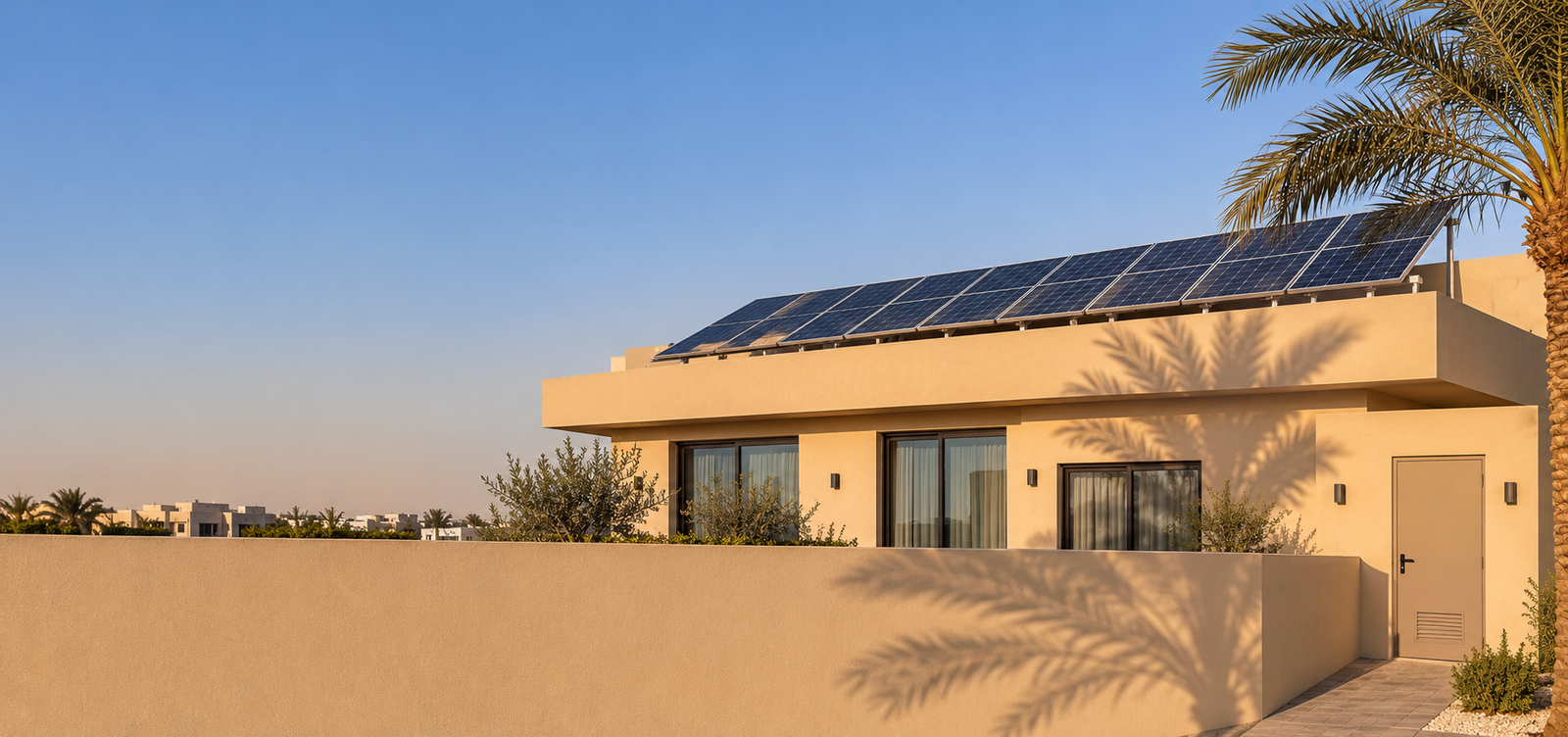
5 – 20 kWh, expandable to 80.4 kWhVilla backup and solar self-consumption, where cooling is most of the load and the peak arrives after sunset.
See the configuration → 02Commercial & industrial
60 – 261 kWh per cabinetDemand charge reduction and peak shaving for factories, cold stores, hotels and water pumping.
See the configuration → 03Off-grid & islands
10 – 100 kWh per systemDiesel hybrid and weak-grid sites where the generator runs too many hours and the fuel bill is the project.
See the configuration → 04Telecom & remote
5 – 50 kWh at 48 VBase stations and remote equipment that must stay up through an outage, unattended, at 55 °C.
See the configuration →The same 261 kWh cabinet is not the same product in Dubai and Manila
Two markets, four constraints. These are the four things that separate a system that lasts seven years from one that fails in the second summer.
| Condition | Gulf | Southeast Asia | What we change |
|---|---|---|---|
| Ambient temperature | 45–52 °C in summer, equipment often unshaded on a roof | 30–38 °C year round, no cool season to recover in | Derating tables at 45 °C and 50 °C in the datasheet; liquid cooling on cabinets above 100 kWh |
| Dust and sand | Fine suspended dust, dust storms in spring, filters clog in weeks | Lower dust load, but high humidity binds it to surfaces | IP65 glands, filtered intakes, sealed busbar compartment, serviceable filter without opening the live section |
| Humidity and salt | Salt fog in coastal and port cities | 70–85% RH all year, salt on island sites | Conformal-coated BMS, stainless fasteners, IP55/IP54 enclosures, anti-condensation heater on outdoor cabinets |
| Grid and paperwork | Weak grid, generator backup, SASO and ESMA registration | Voltage sag, frequent outages, country-specific import registration | Genset-friendly charging, configurable low-voltage ride-through, zero-export option, document pack per destination |
The 20 kWh on our catalogue is an entry point, not a ceiling
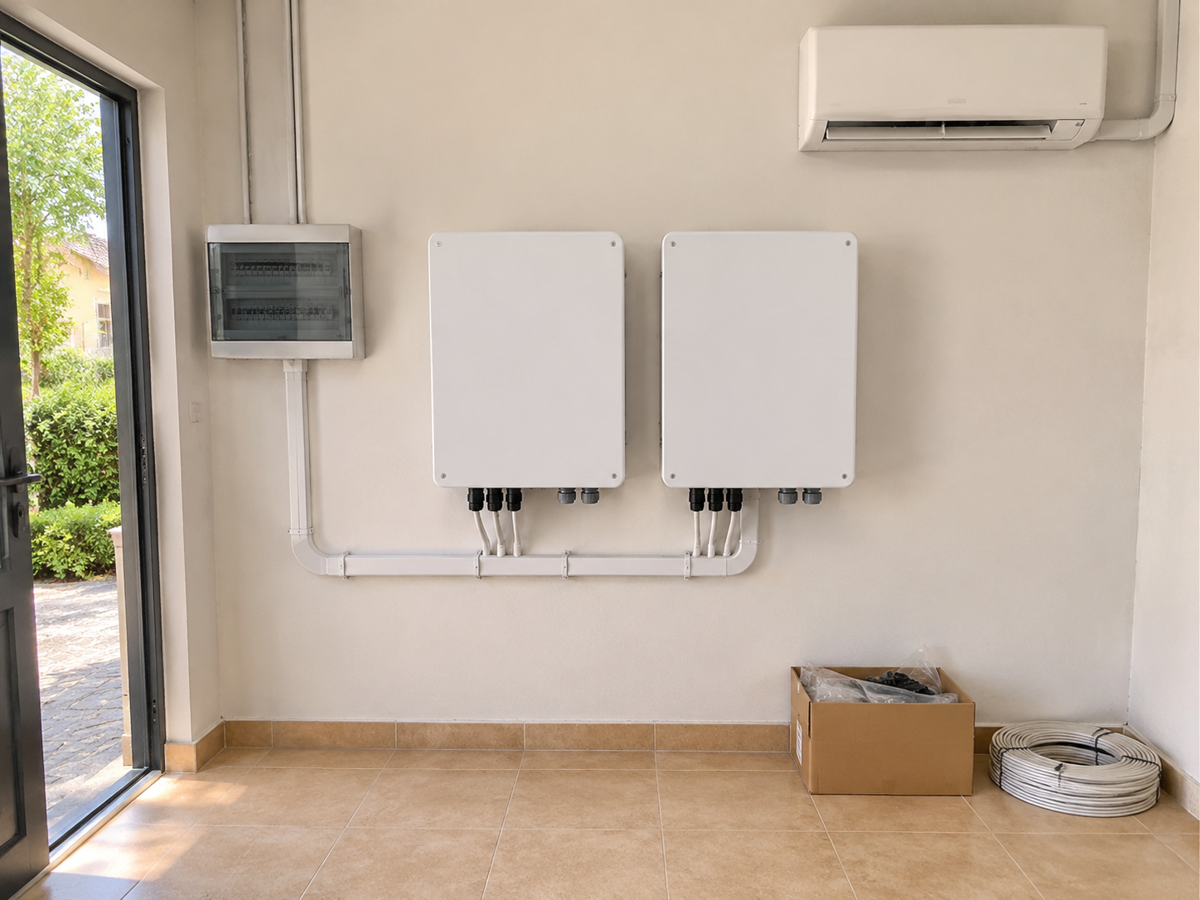
A villa in Riyadh and an apartment in Lyon can have the same annual consumption and need completely different batteries. In the Gulf the cooling load starts at 11 am and is still drawing three kilowatts at midnight. A system sized on annual kWh — the way most online calculators do it — is empty by nine on the first hot night. So we size on the night curve, which usually lands between 20 and 40 kWh, not at the 5 kWh the brochure starts from.
What we specify: stacked modules at 51.2 V, 100 A continuous discharge, IP65 enclosure with sealed glands for a utility room that is really a plant room, and a derating table that shows what the pack delivers at 50 °C rather than at 25 °C. If your inverter needs specific CAN parameters, we set them on our bench and send the configuration file with the serial number.
- Derating at 45 °C and 50 °C in the datasheet, not on request.
- Single-side service clearance of 600 mm — plant rooms are narrow and nobody plans for it.
- BMS parameter file handed over, so the installer is not guessing on site.
Peak shaving is a spreadsheet problem before it is a battery problem
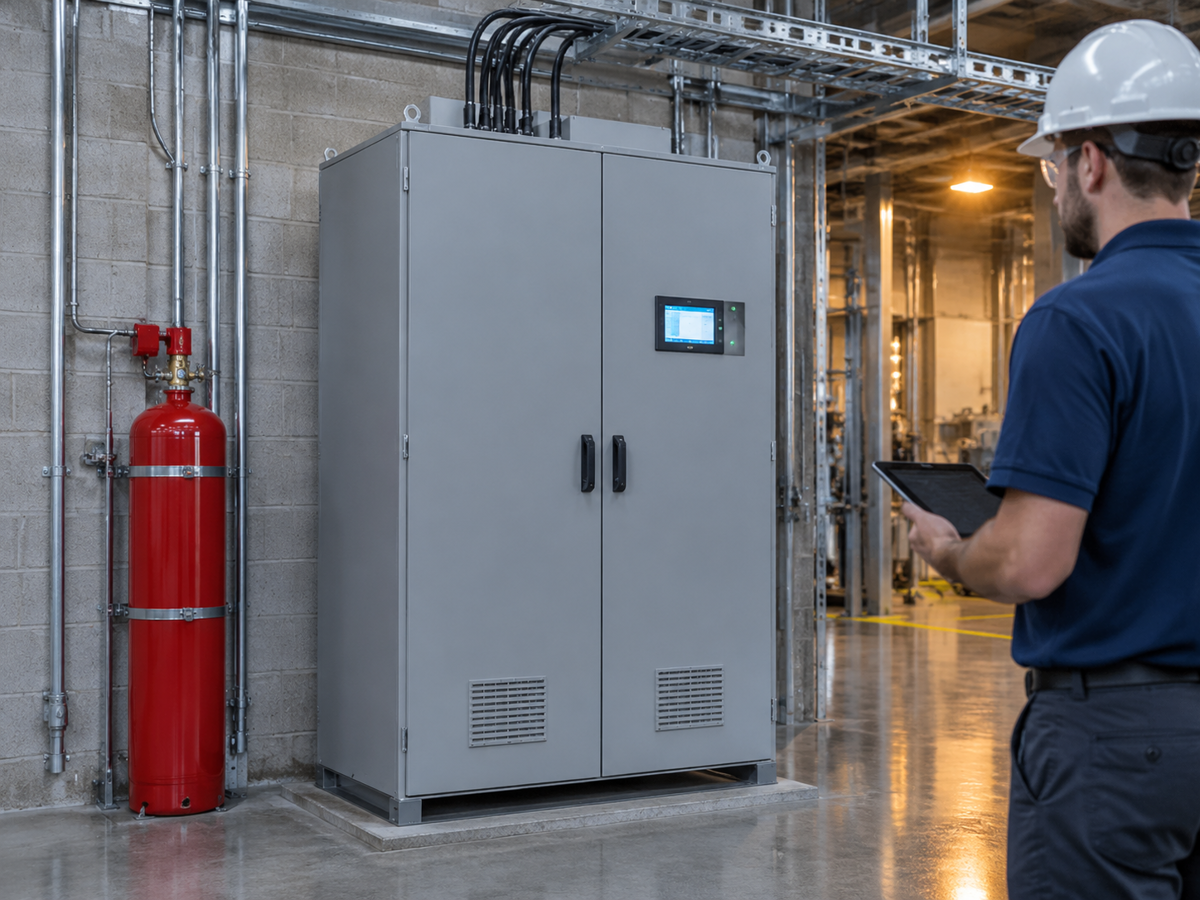
A 400 kW factory on a 250 kW demand cap does not need “a 261 kWh cabinet”. It needs the number of kWh that keeps the monthly peak under the cap, and the number of cycles your tariff allows before the battery stops earning. That is arithmetic on your last twelve bills — we do it before we quote, and we show you the working so your finance team can check it.
In Gulf and Southeast Asian plants the cabinet usually sits in a plant room at 42–45 °C, discharges for two hours, and has to obey a zero-export rule the utility wrote ten years ago. Liquid cooling, Modbus TCP to the SCADA you already run, and an EMS that logs every trip are what make it survive year three, when the warranty conversation starts.
- C-rate stays inside the cell spec at 2-hour discharge, so cycle life is not traded for peak.
- Zero-export and anti-backflow configured before shipment, not left to commissioning.
- Modbus TCP / RTU register map handed over with the unit.
+ shifted kWh × (peak tariff − off-peak tariff)
Send the bill and we run it on your numbers, not on a brochure figure.
The generator should run four hours, not fourteen
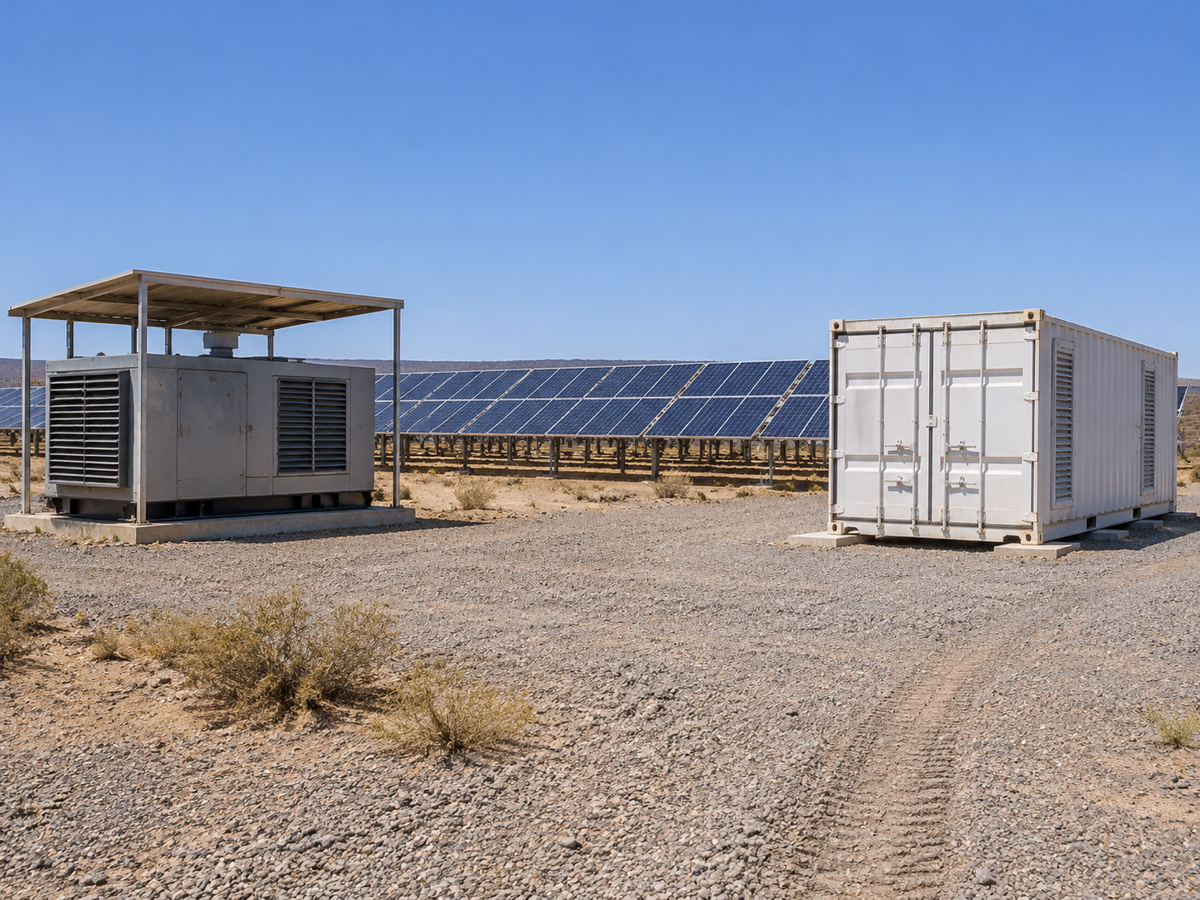
On an island, a mine or a farm, the diesel bill is the project. A battery plus PV typically moves generator hours from fourteen down to four to six and cuts fuel by 60–70% — the exact figure depends on your load profile, which is why the first thing we ask for is a week of logger data, not a budget.
Off-grid systems fail on surge, not on energy. We size the PCS for the pump and compressor starts rather than the average load, and we configure generator-assisted charging at poor power factor — the weak-grid case where cheap hybrids trip the genset and the battery gets blamed.
- Surge sizing for pump and compressor starts, documented in the quote.
- Low-voltage ride-through and genset-friendly charging, so the generator is not fighting the inverter.
- Anti-condensation heater and filtered intake for coastal and dusty sites.
Two hours of downtime costs more than the battery
A base station is outdoor, unvisited, and 50 °C inside the shelter at three in the afternoon. The battery is not there to save energy. It is there so the site stays up through a six-hour outage, and so the NOC sees a weak string before the site goes dark rather than after.
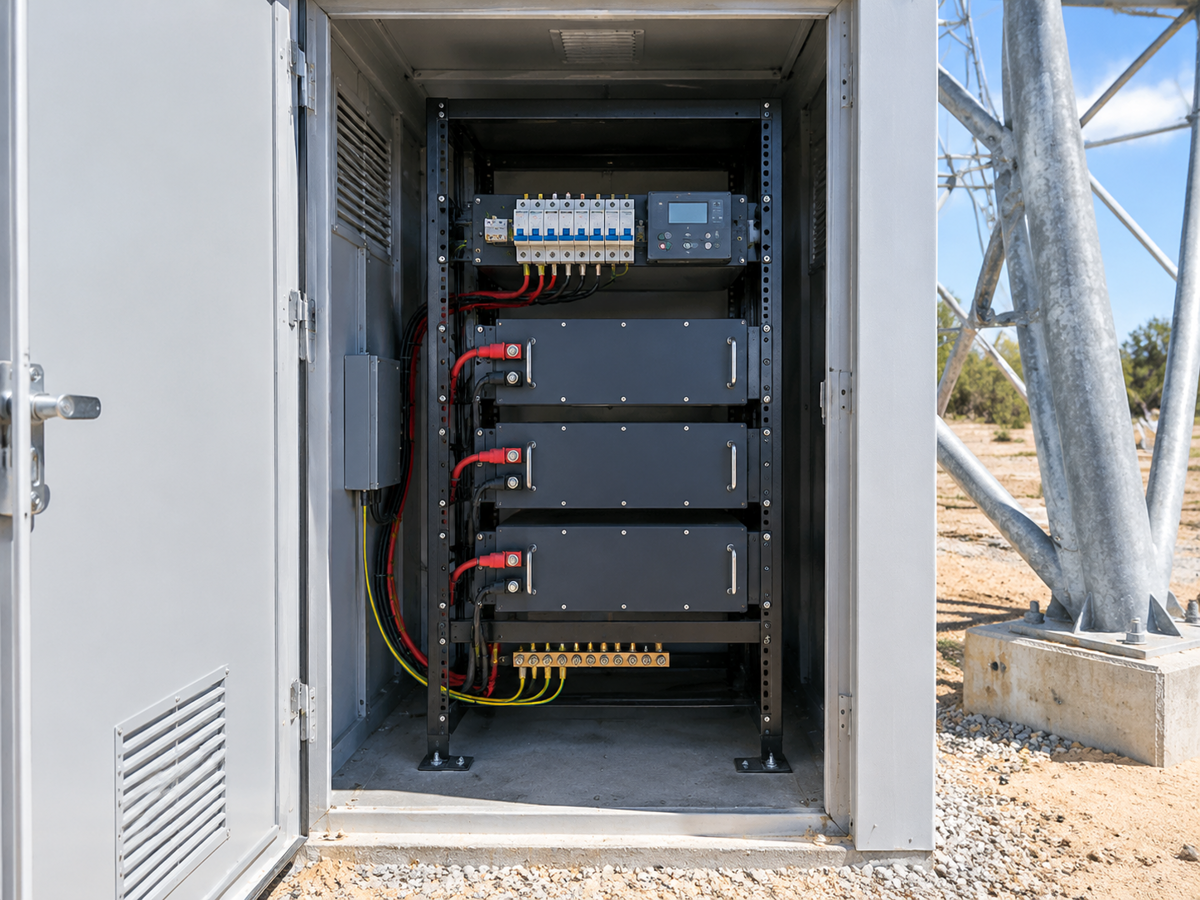
We ship 48 V modules in 19-inch format with an optional DC distribution panel, so a lead-acid bank in an existing shelter can be replaced without rebuilding the room. Alarm reporting comes out of the BMS over SNMP or Modbus — not from a second box you have to power and mount.
- Front-access modules for shelters with 600 mm aisles and no room to pull a rack.
- Alarm mapping sheet for your NOC, written in their language, not ours.
- Expansion in the same rack when a site adds a second operator or a 5G load.
Four applications, side by side
Use this to rule a scenario out. For the capacity inside each row, send the load data and we will size it.
| Application | Daily energy | Recommended capacity | Product line | How it scales |
|---|---|---|---|---|
| Residential | 15–45 kWh/day, of which 10–25 kWh at night | 20–40 kWh typical; 5–20 kWh for apartments | Stacked Home ESS | Modules added to the same stack, one BMS |
| Commercial | 200–800 kWh shifted per day | 60–261 kWh, one to four cabinets | C&I Storage Cabinets | Parallel cabinets, single EMS |
| Off-grid | 30–600 kWh/day, load profile required | 10–100 kWh per system | All-in-One ESS, cabinets | Add PV and genset inputs; containerised above 100 kWh |
| Telecom | 5–20 kWh/day | 5–50 kWh at 48 V | Battery Packs & Modules | Additional modules in the same rack |
Lead time depends on configuration and season. Send the model and quantity with your RFQ and we confirm it in writing, together with the shipping documents for your destination.
What we need before we can size anything
Four inputs. Without them a capacity is a guess, and a guessed capacity is how projects end up with a battery that is either 40% too small or 60% over budget.
- Twelve months of electricity bills. Monthly kWh and the peak demand charge. For a new site, one week of logger data is enough to build the profile.
- The peak you must not exceed. The kW cap in your contract, and what the utility charges when you cross it.
- Grid, off-grid, or generator. If there is a generator, its kVA and age — an old genset and a new inverter do not always cooperate.
- Site conditions. Summer maximum ambient, shaded or unshaded, altitude, and whether the room is air-conditioned.
The arithmetic, so you can check it
We do not hide the sizing behind “our engineers will advise”. This is the calculation, and you can run it yourself before you talk to us:
40 kWh night load ÷ 0.90 DOD ÷ 0.92 efficiency
≈ 48 kWh of nameplate capacity
Then check the C-rate:
48 kWh × 0.90 ÷ 2 h = 21.6 kW continuous
Size the PCS at or above that number.
If the arithmetic says a battery does not pay back in your tariff, we will say so. A system that never returns its cost is worse for us than a lost order, because it comes back as a warranty claim in year three.
What we do not take on
Being clear about this saves both sides a week of emails.
×Retail single-unit orders
We are a factory, not a webshop. MOQ applies per model; below it the tooling and test time do not cover the paperwork.
×Cell-only requests
We assemble packs and systems. We do not manufacture cells and we will not pretend to be a cell supplier to win a battery order.
×Projects with no installer and no commissioning plan
We can recommend partners in most Gulf and Southeast Asian markets, but we will not ship a container into a vacuum.
×Sites above 2,000 m or sustained below −20 °C
Possible, but only after an engineering review. We would rather decline than derate quietly and let you find out in winter.
Send the bills, not a wish list
One email with your last twelve bills and the summer ambient gets you a capacity, a product line, a price, and the document pack for your destination. If the numbers say storage does not pay back for you, we will tell you that too.
WhatsApp: +86 159 0046 9197 · First reply within 12 working hours