

FAMILY 13 · CONTAINER ESS · 3 BUILDS
5 MWh Container Energy Storage System, 1,331.2V DC, 3.34 to 5.01 MWh
Battery, BMS, thermal management and fire suppression inside a 20 or 40 foot shell, IP55, rated to 0.5C. Three builds on one 416S platform, 3,328 to 4,992 LFP cells. The PCS is not in the box, and this page says so before you quote.
5.01 MWh
Largest build, 4,992 cells at 12P416S
1,331.2 V
Nominal DC, 416 cells in series
2.5 MW
0.5C on the 5.01 MWh build
43 t
Shipping weight, heavier than an ISO 40ft rating
WHO THIS IS FOR
One delivery, one commissioning, one asset on the balance sheet
This is not an installer product. It goes to EPCs, developers and utilities putting a front-of-meter or behind-the-meter asset on a pad, where the bank or the offtaker wants a single warranty boundary and a single factory test report rather than forty cabinets wired on site.
Everything DC is inside: cells, racks, BMS, HVAC, fire suppression, container shell. Everything AC is outside: the PCS, the transformer, the switchgear and the EMS. That split is the single thing to understand before you ask for a price, which is why the next section is a list of what is not in the box.
It does not suit anyone below about 1 MWh, anyone without a crane and a 2 t/m² pad at the site, or anyone who needs the plant energised within sixty days.
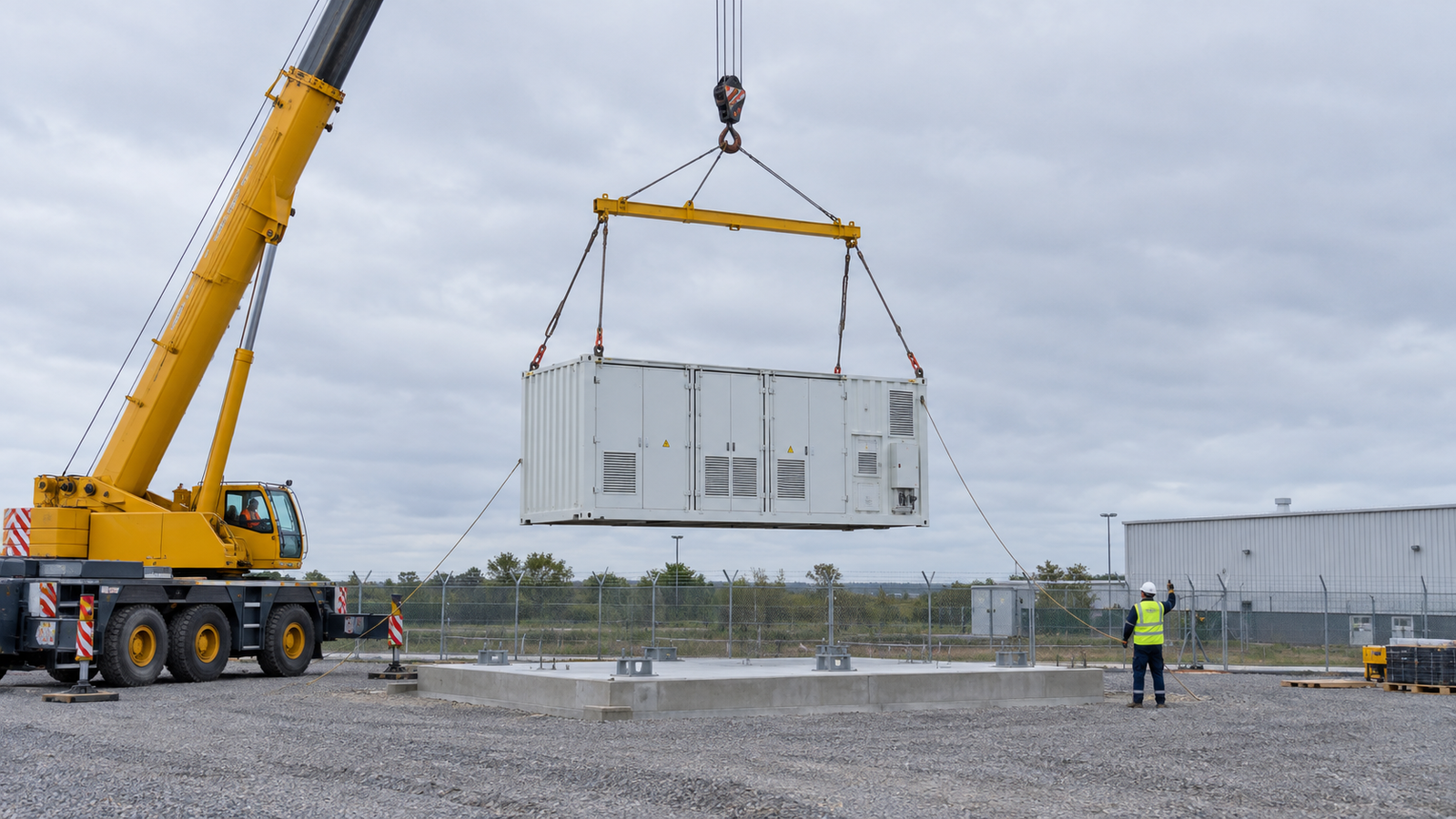
A 43 t lift needs a 50 t crane and a plan, not a forklift and a morning.
THREE BUILDS, ONE PLATFORM
Same voltage, same cell, more strings in parallel
All three builds sit at 1,331.2V nominal and differ only in how many 314Ah strings are paralleled behind that voltage. That is why the DC range, the temperature window and the enclosure rating are identical across the table, and why the price difference is almost entirely cells and rack steel.
| Build | Configuration | Nominal energy | DC range | Max power at 0.5C | Cells | Weight | Energy density |
|---|---|---|---|---|---|---|---|
| 3 MWh | 8P416S | 3.34 MWh | 1,164.8–1,497.6V | 1.67 MW | 3,328 | 33 t | 101 Wh/kg |
| 4 MWh | 10P416S | 4.18 MWh | 1,164.8–1,497.6V | 2.09 MW | 4,160 | 38 t | 110 Wh/kg |
| 5 MWh | 12P416S | 5.01 MWh | 1,164.8–1,497.6V | 2.50 MW | 4,992 | 43 t | 117 Wh/kg |
Cells counted at 416 in series per string, 314Ah each, 3.2V nominal. Energy density is system level: nominal energy divided by the shipping weight in the catalogue, so it already includes racks, HVAC, fire system and shell. Container size is listed as 20FT/40FT for all three builds without saying which is which; ask before you plan transport.
WHAT IS IN THE BOX, AND WHAT IS NOT
The catalogue prints no AC parameters for this product
Look at the container page and you will find voltage, capacity, cooling, fire suppression and weight. You will not find a single kW, amp or grid code. That is not an omission, it is the product boundary: this is a DC block. Get the boundary wrong and the quote is wrong by the price of a PCS.
| Inside the container | You supply, or we quote separately |
|---|---|
| 314Ah LFP cells, 8P / 10P / 12P × 416S, on racks | PCS / bidirectional inverter. 1.67 to 2.50 MW depending on build |
| BMS at module, rack and system level | MV transformer and switchgear if you connect above 1 kV |
| HVAC: air-cooled or liquid-cooled, your choice at order | EMS and SCADA. The container answers on LAN, RS485 and CAN; the software that reads it is not included |
| Fire suppression: aerosol plus water | Gas detection. Temperature, smoke and CO sensors are listed on our 261 kWh cabinet and not on this page. Ask for them explicitly |
| Protection: overvoltage, overcurrent, short circuit, overtemperature, emergency stop | Foundation, cable trench, fencing, lighting, CCTV |
| IP55 shell, C3 corrosion as standard, C4 or C5 on request | Grid-connection testing and the local grid code report |
SITE REQUIREMENTS
Four numbers to check before the vessel books
This is the part of a container project that goes wrong, and it goes wrong before the hardware arrives. None of it is in the catalogue.
01 FLOOR
1.4 to 2.2 t/m²
43 t over a 40ft footprint is about 1.45 t/m². The same 33 t over a 20ft footprint is 2.23 t/m². A pad on fill needs a structural check, not a guess.
02 LIFT
50 t crane minimum
43 t at a working radius of 10 m needs more than a nominal 50 t machine. Send us the site plan and we return the lift chart with the shipping documents.
03 ROAD
Permit territory
33 to 43 t exceeds a standard container chassis rating in most countries. Assume an abnormal-load permit and an escort, and budget days, not hours.
04 CLEARANCE
1 m all round
HVAC intake on one end, exhaust on the other. A container pushed against a wall derates in summer. Door swing at the access end is another 1.5 m.

Four containers, one pad transformer, one switchgear enclosure, one EMS. The container is one line item in a project, not the project.
THERMAL AND FIRE
Air or liquid, and why the storage temperature is not the operating temperature
| Item | Catalogue figure | What it means on site |
|---|---|---|
| Cooling | Air-cooled or liquid-cooled, chosen at order | Air costs less and is simpler to service. Liquid holds cell temperature tighter across a 5 MWh block, which is where cycle life is decided |
| Operating ambient | −30 to 55 °C | 55 °C is an ambient rating, not a full-power rating. Above 45 °C expect derating, and ask for the curve in writing |
| Storage | −20 to 35 °C | The narrow one. A container parked in a Gulf yard in July sits above 35 °C inside. Store it shaded, or accept calendar ageing before it is ever energised |
| Noise | ≤80 dB | Roughly a truck at 10 m. Fine on an industrial plot, a problem at a site boundary next to housing without a barrier |
| Efficiency | ≥90% including self-consumption | That 10% is the number the owner pays for: HVAC, BMS and controls running 24 hours. It is not the same figure as DC round-trip |
| Corrosion | C3 standard, C4 or C5 optional | Coastal Gulf and island sites need C5. Take it at order; you cannot upgrade paint on a commissioned DC block |
| Altitude | ≤2,000 m | A hard limit with no derating clause. Above 2,000 m this product is out, and so is the warranty |
| Fire | Aerosol plus water suppression | No perfluorohexanone on this page, though our 261 kWh cabinet has it. If your fire consultant specifies a clean agent, raise it before the order |
INSIDE THE SHELL
What a 5 MWh DC block actually looks like

Racks down both sides, DC busbar overhead, HVAC duct along the ceiling. Aisles wide enough for a module on a trolley.
Twelve strings of 416 cells is 4,992 cells in one enclosure, at 1,331.2V. Nothing about that is serviced live. The maintenance model is: isolate a string, pull a module on a trolley, replace, rebalance.
That is why the aisle width and the module weight matter more than the headline energy. Ask for the module weight before you plan a maintenance contract, because a 60 kg module and a 110 kg module are different jobs with different labour.
One spare module on site is not optional. A single failed module takes a string out of service until a replacement clears customs. On a 5 MWh asset the revenue loss crosses the price of the spare within a month.
CERTIFICATION
A 5 MWh asset is asked for more paperwork than a cabinet
UN 38.3
Cell and module level transport test summary. On a container shipment the forwarder will ask for this plus the state of charge declaration, usually 30% or below.
System level
The catalogue prints no system certificate for this product. Your offtaker will ask for IEC 62933-5-2 and a grid-code report. Tell us the destination country and we send what we actually hold, not what is usually claimed.
ISO 9001
Plant level, covering the Hangzhou site. For a utility-scale tender this is the minimum entry ticket, not a differentiator.
BUYING INFORMATION
What the order actually looks like
| Minimum order | One unit. This is not a volume product, and a single container is a normal first order. |
| Lead time | 45 to 60 days after the deposit clears, plus ocean transit. Container builds are assembled to order, so the clock starts later than a cabinet. |
| Shipping | The unit is the container, but the weights in this table exceed a standard 40ft rating. Confirm the packing breakdown with us before the forwarder books space. |
| State of charge | Ships at 30% or below for transport classification. Plan a commissioning charge at site before the first cycle test. |
| HS code | 8507.60 for the DC block. If it ships with a PCS inside the same frame, the classification may change. Confirm with your broker before the first shipment. |
| Trade terms | FOB Ningbo or CIF to your port. For a 43 t lift at destination, agree who provides the crane in the contract, not on the phone. |
| Spares | Order one spare module and one spare HVAC controller with the unit. Both are cheap at the factory and slow to arrive later. |
COMMISSIONING NOTES
Six things that decide whether it energises on schedule
- Pad before vessel. A level pad, cured, with the cable trench in place. A container that arrives before its foundation sits on the truck for a week, and the demurrage is yours.
- Level to 5 mm. The shell is rigid; a twisted pad puts the racks out of plane and the doors stop sealing. This is the most common installation defect on container systems.
- Do not store it in the sun. Storage window is −20 to 35 °C. A container in a yard through a hot season ages before it earns anything.
- Insulation test before first charge. 1,331.2V DC is not a voltage to assume. A megohmmeter reading before energising is what the commissioning report needs.
- SOC calibration, then capacity test. Ship at 30%, so the first full charge is also the first calibration. Do not skip straight to a performance test.
- Fire system test witnessed. Aerosol and water suppression both need a witnessed functional test for most approvals. Book the witness with the AHJ before the crew demobilises.
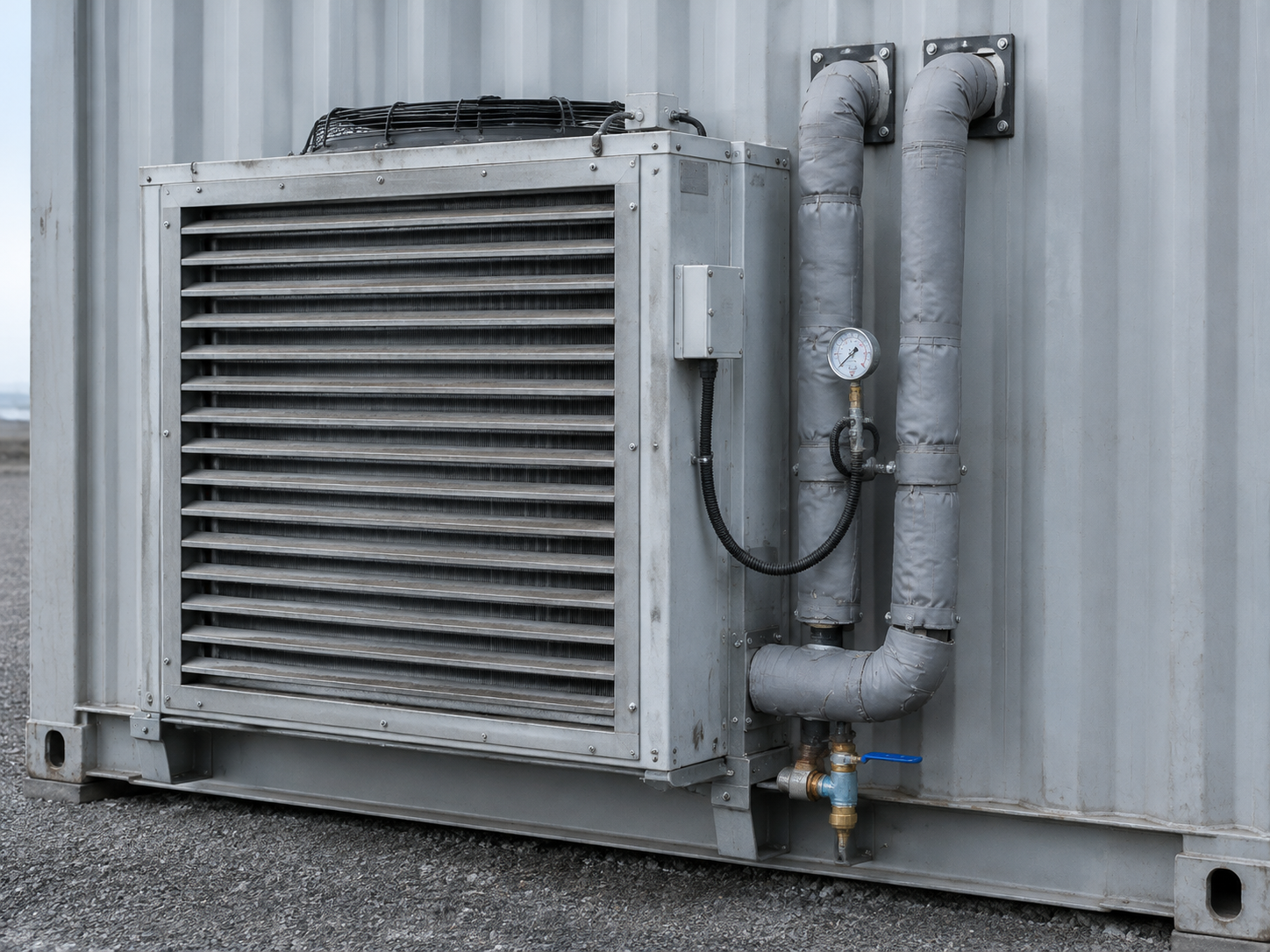
Cooling skid on the end wall. Service access here is why the 1 m clearance is not negotiable.
QUESTIONS
Six things buyers ask about this family
Is the PCS included?
No. The catalogue prints no AC-side parameters for this product at all, which is the clearest possible signal that it is a DC block. You need a 1.67, 2.09 or 2.50 MW bidirectional PCS depending on the build, plus a transformer if you connect above 1 kV. We can quote the PCS separately; we will not assume it into the container price.
Which build goes in a 20ft and which in a 40ft?
The catalogue lists 20FT/40FT against all three builds and does not say which is which. Ask before you plan transport or a foundation, because the footprint difference changes the pad, the crane position and the floor loading: 33 t on 20ft is about 2.23 t/m², 43 t on 40ft is about 1.45 t/m².
Can it be installed at 2,500 m?
No. The rating is 2,000 m with no derating clause printed. Above that the HVAC cannot reject enough heat at the air density available, and the warranty position is not something we can soften after the fact. For high-altitude sites, tell us at enquiry and we will say no early rather than late.
Air-cooled or liquid-cooled, which should I take?
Air is cheaper, has fewer parts and any HVAC technician can service it. Liquid holds the cells within a couple of degrees across the whole block, and on a 5 MWh asset that is what decides whether you get the cycle count you paid for. For a Gulf site running a daily 0.5C cycle, take liquid. For a temperate site at 0.25C, air is defensible.
What fire protection comes with it, and is detection included?
Aerosol plus water suppression is listed as standard. Detection is not listed on this product page, although our 261 kWh cabinet does list temperature, smoke and CO sensors. Most authorities will require detection before they approve a 5 MWh installation, so confirm it at the order stage. Retrofitting sensors into a commissioned DC block is an outage, not a service visit.
What is the cycle life and the warranty?
Neither is printed for this product. The 314Ah cell inside it carries a 6,000-cycle rating at 90% depth of discharge elsewhere in the catalogue, and the cabinet built on the same cell states 6,000 cycles. For the container, ask us for the figure tied to your duty cycle and the warranty term that goes with it, in writing, before the order. We would rather give you a number you can hold us to than a marketing one.
QUICK QUOTE
Send the site, the duty cycle and the grid connection
Tell us the country, the required MWh and MW, whether you connect at low or medium voltage, the local ambient in the hottest month, and whether the site is coastal. We come back with the build, the PCS suggestion, the packing breakdown and a price, usually within 24 hours on a working day.
Related families: 261 kWh High-Voltage Cabinet · All C&I systems · Utility-scale solutions · Back to all products