
FAMILY 04 · WALL-MOUNTED · 1 MODEL
2.5 kWh Wall-mounted LiFePO4 Battery, 24V 100Ah, 23.5 kg
A small wall battery for one circuit, one cabin, one telecom box. 2.56 kWh, 100A charge and discharge, 6,000 cycles, and it hangs on a bracket with four screws. It is not a whole-house backup, and this page says what it actually runs.
2.56 kWh
24V 100Ah, 2.3 kWh usable at 90% DoD
100 A
2.56 kW each way, 1C on a small pack
23.5 kg
One person, one bracket, four screws
6,000
Cycles, LiFePO4, Grade A cells
WHO THIS IS FOR
One circuit, not one house
2.56 kWh is about a day of a fridge, or two and a half hours of a 1 kW heater. That is a real and useful amount of energy, but it is not a whole-home backup, and a buyer who expects one will be disappointed on the first night. So this page is written for the job it actually does: keeping a router, a fridge, a medical device or a telecom box alive.
It suits a cabin or a workshop on a small array, a gate or a camera post, a telecom cabinet that needs four hours of hold-up, a boat with a 24V system, and any retrofit where the battery has to go on a wall in a space that is already finished.
It does not suit a house with an air conditioner and an electric stove. For that, look at the stacked battery, which starts at 5.12 kWh and reaches 80.4. It also does not suit an outdoor wall, because our datasheet prints no IP rating for this model.

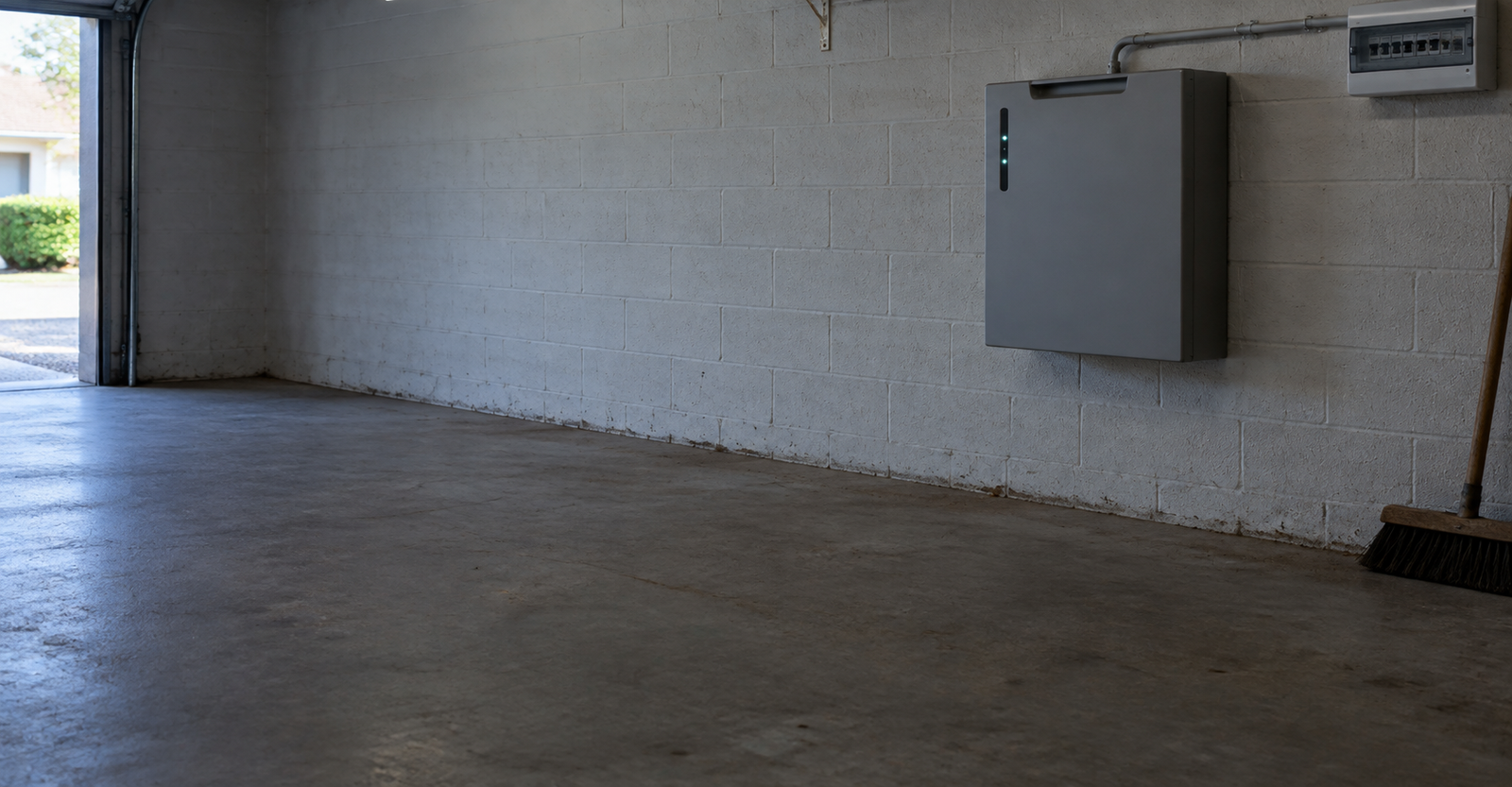
380 × 415 × 150 mm, 23.5 kg. Slim enough to sit behind a door.
THE ONE MODEL
Everything the datasheet prints, in one place
One build, one column. Where our datasheet is silent, the row says so rather than guessing, because those gaps are what a technical buyer will ask about first.
| Model | 24V 100Ah wall-mounted |
| Chemistry | LiFePO4, Grade A prismatic cells |
| Nominal energy | 2.56 kWh (printed as 2.5 kWh and as 2,560 Wh on the same page) |
| Nominal voltage / capacity | 25.6V / 100Ah, working range 22.4–28.8V |
| Max charge current | 100 A · 2.56 kW · 1C |
| Max discharge current | 100 A · 2.56 kW · 1C |
| Cycle life | 6,000 cycles, depth of discharge not stated |
| Communication | RS485 / RS232 / CAN |
| Operating temperature | −10 to 60 °C |
| Weight | 23.5 kg |
| Dimensions L × W × H | 380 × 415 × 150 mm |
| Installation | Wall-mounted on a bracket |
| IP rating | Not printed in our datasheet |
| Warranty | Not printed in our datasheet |
| Parallel limit | “Supports parallel connection”, number not stated |

Rear face: a full-width steel bracket, two terminals on the right, comms plate below.
150 mm deep, and that is the whole point
Most 24V batteries are a plastic box that has to stand on something. This one is 150 mm deep, so it goes on a wall in a corridor, behind a door, above a workbench, or on the bulkhead of a boat where there was never floor space.
The bracket carries the weight; the wall only has to resist 23.5 kg in shear plus a small pull-out. Into masonry that is four M8 anchors. Into plasterboard on studs, find the studs, or fit a ply pattress first.
Do not hang it above a bed or a doorway. A bracket that has held for two years can still be undone by someone leaning on the unit while decorating.
WHAT 2.56 kWh ACTUALLY RUNS
The table that decides whether this is the right battery
Figures below use 2.3 kWh, which is 90% of nominal. The datasheet does not print a recommended depth of discharge for this model, so 90% is our design assumption, not a factory figure.
| Load | Draw | Runtime | Verdict |
|---|---|---|---|
| Router, ONT and two LED lights | 45 W | 51 hours | Two days of internet on a 2.5 kWh battery |
| 12V compressor fridge | 50 W average | 46 hours | The classic cabin use. Works |
| CPAP, laptop and phone charging | 90 W | 25 hours | Three nights. This is why people buy it |
| Small air conditioner, 1 HP | 700 W | 3.3 hours | Survivable for one hot night, not for a season |
| 1 kW heater or hair dryer | 1,000 W | 2.3 hours | Possible, and a waste of a battery |
| 2 kW kettle | 2,000 W | 1.2 hours | Runs one boil, because 2.56 kW of surge is available |
| Whole house with AC and cooking | 3–5 kW | Under 1 hour | Wrong product. Buy 10 kWh or more |
VOLTAGE, INVERTER AND PARALLEL
This is a 24V battery, and one line of our own copy says otherwise
Our brochure prints “Operates on safe 51.2V DC” on this model’s page. The specification on the same page says 25.6V nominal, and the model number says 24V. The specification is right. That sentence is left over from the 51.2V family and it is being corrected.
| Question | Answer for this model | What to check |
|---|---|---|
| What inverter? | A 24V hybrid or off-grid inverter | Not a 48V unit. A 48V inverter will not start on 25.6V, and a 12V one will be damaged |
| Charge voltage | 28.8V top of range | Set absorption to 28.4 to 28.8V. A 24V lead-acid profile at 29.4V will trip the BMS |
| Parallel | Supported, number of units not stated | Ask us for the limit and the addressing method before you sell a bank |
| Communication | RS485, RS232, CAN | Three ports, so it will talk to most 24V inverters. The mobile app in our brochure implies a Bluetooth or WiFi module that is not in the port list |
| Series connection | Not stated | Two in series for 48V is physically possible and not approved in writing. Do not do it |
CERTIFICATION
What the paperwork covers
UN 38.3
Transport test summary. A 23.5 kg pack ships as Class 9 in a single carton, which keeps freight simple compared with a palletised cabinet.
CE & RoHS
Issued per model. Ask for the report number that covers the 24V build specifically; a 51.2V report does not transfer.
IEC 62619
The one a European or Gulf buyer asks for on a stationary battery. Tell us the destination and we confirm what we hold for this model rather than assuming it carries over.
TYPICAL CONFIGURATIONS
Three builds we ship most often
Examples, not guarantees. Runtimes use 2.3 kWh usable.

A cabin wall: battery, 24V inverter, solar controller and a small distribution board, all within one metre.
CABIN, LIGHTS AND FRIDGE
1 × 2.56 kWh · 24V
A 12V compressor fridge at 50 W average plus lights and a phone charger, about 80 W in total. Roughly 28 hours, and 600 W of panels puts back a day’s use by early afternoon.
23.5 kg · on a bracket, off the floor
TELECOM OR CAMERA POST
2 × 2.56 kWh · 5.12 kWh
Two units paralleled where the parallel limit allows it. A 40 W camera, radio link and switch run about 115 hours, which covers five overcast days without a site visit.
47 kg · confirm the parallel limit first
MEDICAL, ONE ROOM
1 × 2.56 kWh · UPS mode
A CPAP at 40 W plus a small fridge for medication, about 90 W. Around 25 hours, which is three nights, and the 1C rating means the fridge compressor still starts on the first try.
23.5 kg · inside the room, not outside
BUYING INFORMATION
What the order actually looks like
| Minimum order | 100 units. A single model line, so mixed pallets are straightforward. |
| Lead time | 15 to 20 days after the deposit clears, counted from payment. |
| Packaging | One unit per carton with foam end caps and the bracket in a separate bag inside. The bracket is easy to lose in a warehouse, so keep it with the unit. |
| Gross weight | Roughly 26 kg with carton and bracket. Small enough for air freight on a sample order. |
| HS code | 8507.60, lithium-ion accumulators. Confirm with your broker before the first shipment. |
| Trade terms | FOB Ningbo or CIF to your port. EXW is available if you have your own forwarder. |
INSTALLATION NOTES
Six things the installer needs to know
- Find the studs, or fit a pattress. 23.5 kg in shear plus a pull-out moment at 150 mm off the wall. Into masonry, four M8 anchors are enough. Into plasterboard, ply first, always.
- Do not hang it over a bed or a doorway. The bracket will hold. The person leaning on it while painting is the risk. Pick a wall nobody walks past with a ladder.
- No IP rating is printed. Until we confirm one, treat this as an indoor product: a plant room, a cabin interior, a garage that stays dry. Not a covered outdoor wall.
- 24V, not 48V. A 48V inverter will not start on 25.6V, and it is not a wiring mistake you find until the first power-up.
- Set absorption to 28.4 to 28.8V. A 24V lead-acid profile at 29.4V will push the BMS into overvoltage disconnect, and the customer will report a dead battery.
- Charging near or below 0 °C. The operating range is −10 to 60 °C but no separate charge window is printed. Assume no charging below 0 °C until we confirm otherwise.

Bracket first, level it, then lift the unit on with two hands. One person at 23.5 kg.
QUESTIONS
Six things buyers ask about this model
Can 2.5 kWh really back up a house?
No. It runs a fridge, lights, a router and a medical device for a day or two, and it will run a small air conditioner for about three hours. A house with an air conditioner and electric cooking needs 10 kWh and up. Say this early: a customer who buys 2.5 kWh expecting a whole-house backup returns the product, and the return costs more than the margin.
Is it 24V or 51.2V? Your brochure says both.
24V. The specification says 25.6V nominal and the model number says 24V, so the “51.2V” line in our brochure is a printing error carried over from the 51.2V family, and it is being corrected. Plan a 24V inverter. We are telling you rather than letting you find out at commissioning.
How many can I parallel?
Our brochure says parallel connection is supported and does not give a number. Ask us in writing before you design a bank, because the limit depends on the BMS firmware and on how the addresses are set. Two units is the common configuration for a camera post or a telecom box, and we will confirm that specific case in writing.
What is the IP rating?
Our datasheet does not print one for this model, so we treat it as an indoor product on this page. If it is going into a garage, a boat locker or a semi-exposed position, ask us for the rating before you order. A wall battery is exactly the product where a buyer assumes IP65 and nobody thinks to check.
Will it run a 2 kW load?
Yes, briefly. The discharge rating is 100A at 25.6V, which is 2.56 kW, so a kettle or a microwave runs. That is 1C on a 2.56 kWh pack, which is high for a battery this small and is the real reason to choose it over a cheaper 0.5C unit. Just do not expect to run 2 kW for an hour: the energy is only 2.3 kWh usable.
What is the warranty, and the depth of discharge?
Our datasheet prints neither for this model. The 6,000-cycle figure comes with no depth of discharge attached, and there is no warranty term on the page at all, which is unusual even for us. Ask for both in writing against your duty cycle before the order, and we will put them on the quotation instead of in a brochure.
QUICK QUOTE
Send the load, the inverter and the wall
Tell us what the battery has to run in watts, how long it has to run, the inverter model and what the wall is made of. We come back with the number of units, the bracket fixing and a price, usually within 12 hours on a working day.
Related families: 12V / 24V Lead-acid Replacement · Low-Voltage Stacked Battery · All battery packs · Back to all products