

FAMILY 06 · PORTABLE POWER STATION · 1 MODEL
Portable Solar Power Station, 5.28 kWh, 3.6 kW Output
A wheeled unit that replaces a small petrol generator on a site with no fumes and no fuel run. 25.6V 206Ah LFP, 7.2 kVA surge, 5 kW of solar input through a built-in MPPT. 60 kg, which is two people and a ramp, not a backpack.
5.28 kWh
25.6V 206Ah, 4.75 kWh usable at 90% DoD
3.6 kW
Inverter rating, 7.2 kVA surge
100 A
Battery limit, 2.56 kW, not 3.6
60 kg
Two people and a ramp
WHO THIS IS FOR
A generator replacement you can wheel into a lift
The comparison is not a camping battery, it is a 2 kW petrol generator. Same job, no fuel, no exhaust, no noise at the boundary, and it can be carried in the back of a van by two people. On a fit-out, an event build, a roadside job or a clinic outreach, that is the whole argument.
It suits sites with no supply for a day or two, locations where a generator cannot run, work that has to be quiet, and any job where someone currently carries a can of petrol up a stair.
It is not a home backup. No parallel option, IP20, and 5.28 kWh is one evening of a house with an air conditioner. For a house, the wall-mounted all-in-one does the same job with more capacity and a fixed installation.

510 × 470 × 360 mm, 60 kg. Wheels and a top handle, like a flight case.
THE ONE MODEL
Everything the datasheet prints
One build. Where our datasheet contradicts itself or stays silent, the row says so, because those are the questions a technical buyer asks first and the ones that decide whether the unit does the job.
| Model | 5.28 kWh / 3.6 kW portable station |
| Chemistry | LiFePO4, 6,000 cycles |
| Battery | 25.6V, 206Ah, 5.28 kWh, working range 22.4–28.8V |
| Battery current limit | 100 A charge and discharge, which is 2.56 kW |
| Inverter | 3.6 kW rated, 7.2 kVA surge, pure sine wave, single phase 208–240V |
| Overload curve | 60 s at 102–110%, 10 s at 110–130%, 3 s at 130–150%, 0.2 s above 150% |
| Solar input | MPPT, 5,000 W / 18 A, window 40–450V, 500V open circuit ceiling |
| Charge current | 100 A from PV, AC or both combined |
| Transfer time | 10 ms in UPS mode, 20 ms on generator input |
| Efficiency | 92.7% in battery mode at 24VDC |
| Display | LCD |
| Ingress protection | IP20 |
| Operating temperature | −10 to 50 °C |
| Storage temperature | −10 to 45 °C |
| Weight / size | 60 kg, 510 × 470 × 360 mm |
| Altitude | 4,000 m, derated above 1,000 m |
| Parallel | Specification says NA. Our brochure bullet says supported. See below |
| Warranty | Not printed in our datasheet |
Parallel Quantity NA. The specification is right for this model. Do not plan a two-unit bank until we confirm it in writing.
3.6 kW OR 2.56 kW
The inverter is rated higher than the battery can feed it
This is the number to get right before you sell one, because it decides what the customer can actually run on battery alone.
| Figure | Arithmetic | What it means |
|---|---|---|
| Inverter rated 3.6 kW | 3.6 kW ÷ 25.6V = 141 A | To deliver its nameplate the inverter needs more current than the battery is rated to give |
| Battery limit 100 A | 100 A × 25.6V = 2.56 kW | The most this pack can feed the inverter, on its own |
| Surge 7.2 kVA | For seconds, not minutes | Starting a compressor is fine. Sustaining 3.6 kW from the battery is not |
SOLAR INPUT
5,000 W of panels and 2.56 kW of charging, both true
The array maximum and the charge maximum are different numbers, and buyers mix them up constantly. Here is what each one applies to.
| Number | Applies to | What happens in practice |
|---|---|---|
| 5,000 W array | The MPPT input, 18 A at up to 450V | A big array is safe and useful: the surplus runs the load directly instead of going through the battery |
| 100 A charge | The battery, 2.56 kW at 25.6V | Whatever the array produces, no more than 2.56 kW goes into the pack. The rest goes to the load or is clipped |
| 500 V open circuit | The string, on the coldest morning | Check Voc at the lowest site temperature, not at 25 °C. Three 550 W panels in series is about right, five is not |
| 40–450 V window | The MPPT tracking range | Two panels in series (about 80V) sits at the low end and works badly in heat. Four to six panels is the sweet spot |
CERTIFICATION
What the paperwork covers
UN 38.3
Transport test summary. A 60 kg unit with a built-in inverter ships as Class 9 on a pallet and the forwarder will want this with the state of charge declaration.
CE & RoHS
On this product the inverter also needs its own EMC and safety file, not only the battery. Ask for both report numbers, not just the pack.
IEC 62619
The stationary battery standard a Gulf or EU buyer asks for. Tell us the destination and we confirm what we hold for this model rather than assuming it carries over from another family.
TYPICAL CONFIGURATIONS
Three jobs we ship this for
Examples, not guarantees. Runtimes use 4.75 kWh usable at 90% depth of discharge, which is our design assumption rather than a printed factory figure.

Two folding panels on the ground, one cable to the unit, work lights running off the front panel.
FIT-OUT, NO SUPPLY
1 × unit · 800 W of lights
Site lighting and a radio charger through an eight-hour shift is about 4.6 kWh, which is one full charge. The unit goes home in the van and charges overnight on mains, or takes 1.6 kW of panels on site.
60 kg · fits a van boot upright
EVENT OR MARKET STALL
1 × unit · 200–600 W
Espresso machine, lights, card terminal and a phone charging station. Bursts hit 2 kW for a minute at a time, which the 7.2 kVA surge covers. Eight to twenty hours depending on the coffee.
Silent · no fumes next to a stall
CLINIC OUTREACH
1 × unit · vaccine fridge
A 12V vaccine fridge at 60 W average plus lighting and a laptop, about 150 W. Thirty-one hours, and the fridge compressor starts reliably because of the 1C-capable pack.
4.75 kWh usable · recharge from mains or panels
BUYING INFORMATION
What the order actually looks like
| Minimum order | 50 units. Single model, so a mixed pallet is not a consideration. |
| Lead time | 20 to 25 days after the deposit clears. The unit is load-tested with the inverter before packing, which is why it is longer than a bare pack. |
| Packaging | One unit per carton on a pallet, foam at all four corners, castors blocked. Ship upright: a unit that has travelled on its side needs an insulation check before it is switched on. |
| Gross weight | About 66 kg with carton and pallet. Air freight is possible on a sample but uneconomic above a few units. |
| HS code | 8504.40 or 8507.60 depending on which function your broker treats as essential. An all-in-one is genuinely ambiguous, so get a written ruling before the first shipment. |
| Trade terms | FOB Ningbo or CIF to your port. EXW is available if you have your own forwarder. |
OPERATING NOTES
Six things the operator needs to know
- 60 kg is a two-person lift. The castors are for flat ground, not for a kerb or a gravel apron. Loading it into a van alone is how the handle breaks and how someone hurts their back.
- IP20 means indoors or under cover. Our brochure says “supports outdoor charging”, and that means the panels are outdoors. The unit itself stays out of the rain. A patio in a shower is not covered by this rating.
- Above 1,000 m it derates. This is the strictest altitude clause in our range: 4,000 m is the ceiling but derating starts at 1,000 m, not 2,000. A site at 1,500 m already loses output, so check before quoting a mountain job.
- No charging below 0 °C assumed. The operating range is −10 to 50 °C but no separate charge window is printed for this model. Storage is −10 to 45 °C, which matters if the unit lives in a van over a cold winter.
- Do not run it at 3.6 kW on battery alone for long. The pack tops out around 2.5 kW. If the tool is 3 kW and there is no sun, the unit will either limit or the overload timer will trip at 130–150% after three seconds.
- Keep the PV string under 500 V cold. Four 550 W panels in series is comfortable. Six is not, on a cold morning, even though the label says 450V MPPT window.

Front face: LCD, two AC outlets with covers, DC output and the main breaker, all on one plate.
MOVING IT
Portable, with a caveat
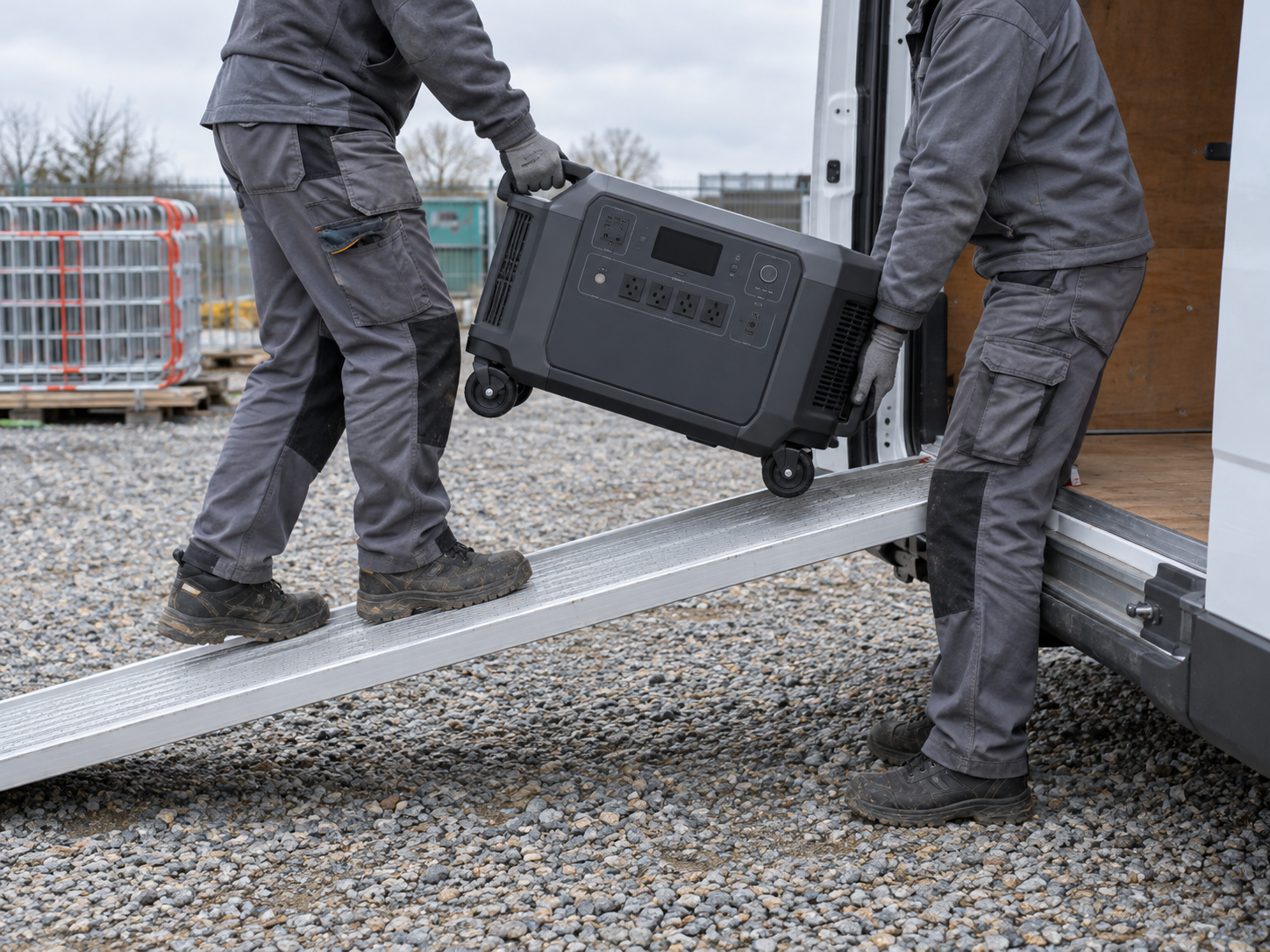
Onto a ramp, not up a step. Two people, one at each end.
At 60 kg this is a two-person move on anything other than flat concrete. That is still a different job from a 25 kg camping station, and a very different job from a 200 kg cabinet, but it is not a one-hand carry.
The castors are the weak point. They are rated for a smooth floor. Dragging the unit across gravel or down a kerb breaks them, and a replacement castor set is not something a customer can fit on site.
Tell your customer the weight before they buy. The word “portable” sets an expectation of one person, and the first complaint on this product category is always the same one.
QUESTIONS
Six things buyers ask about this model
Can it really deliver 3.6 kW?
The inverter is rated at 3.6 kW with a 7.2 kVA surge, but the battery is limited to 100A, which is 2.56 kW at 25.6V. To hit 3.6 kW the panels have to be contributing at that moment. On battery alone, plan on about 2.5 kW continuous. If your load is a 3 kW tool and the site is in shade, this is the wrong unit.
Can I run two of them together for more power?
Not on this model. Our specification says Parallel Quantity NA, although a bullet on the same brochure page says multi-unit parallel is supported. The specification is right: this is the smaller platform and it has no parallel port. For more capacity in one box, look at the wall-mounted all-in-one or the cabinets.
Can it sit outside while charging from panels?
The panels go outside. The unit is IP20, so it does not. Under a canopy, in a tent porch, inside a van with the cable out of the window: all fine. On a patio in the rain: not covered by the rating, and water ingress is not a warranty event. Our brochure phrase “supports outdoor charging” refers to the array, not the enclosure.
How much panel can I connect, and will it charge faster?
Up to 5,000 W of array, but charging stops at 100A, which is 2.56 kW. Going from 2 kW to 5 kW of panels does not shorten the charge time much; what it does is let the unit run a big load with the sun covering it instead of the battery. Keep the string under 500 V at the coldest morning and inside the 40–450V MPPT window.
Will it start a fridge or an air conditioner?
A fridge, yes, comfortably. The 7.2 kVA surge and the 1C-capable pack handle compressor start. One 1 HP air conditioner runs for about four hours on a full charge, which is realistic for a night in a hot place. Two air conditioners is beyond both the energy and the current.
What is the warranty, and the depth of discharge?
Our datasheet prints neither for this model. The 6,000-cycle figure has no depth of discharge attached and there is no warranty term on the page. Ask for both in writing against your duty cycle before the order, so they end up on the quotation rather than in an argument eighteen months later.
QUICK QUOTE
Send the tool list and the shift length
Tell us what has to run, the watts and the hours, whether the site has sun and what it currently uses instead. We come back with the number of units, the panel size and a price, usually within 12 hours on a working day.
Related families: Low-Voltage All-in-One · 261 kWh Cabinet · All all-in-one systems · Back to all products